Stoke Gabriel Primary School

Reading

Bug Club Phonics          

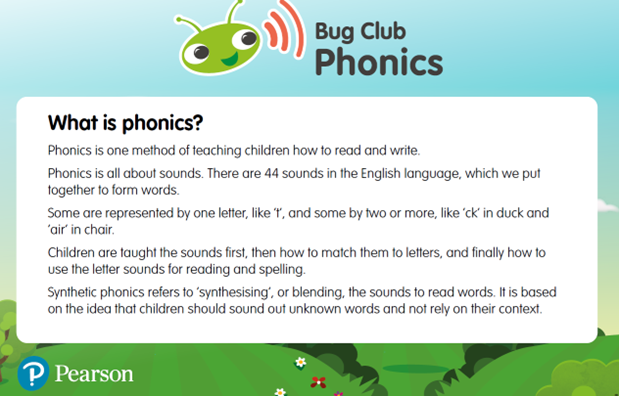
Stoke Gabriel Primary School has chosen to use the Bug Club Phonics programme to help your child learn to read. The programme follows an approach of synthesising phonemes associated with graphemes a child sees; or put another way, learning to read by blending the sounds associated with the letters a child sees. The programme is the product of extensive research on the best way to teach children how to read.

Daily Phonics

Children will have daily phonics lessons as soon as they start reception, continuing through year 1 and beyond as needed.

Year 1 children will take the National Phonic Check in June. More information can be found here: Phonics screening check: information for parents - GOV.UK

Learning to read

The reading books your child brings home are designed to support them in practising and consolidating the learning they have done at school. They also enable children to experience the pleasure and pride of reading their own books.

All the books in Bug Club Phonics have been finely-levelled to ensure that all children can read books at exactly the right level for them.

In addition to daily teaching sessions, children will be given regular opportunities to practice sounding and blending words in a meaningful context. Children will read a book at least 3 times a week, using the same book to complete 3 re-reads to develop fluency and confidence. These reads may be repeated as needed.

Alongside their decodable book, all children will take a choice book home to share with you.

bug-club-phonics-scope-sequence-progression-chart.pdf


Additional parent information.

Introduction to Bug Club here:

https://youtu.be/44mZZQfgkjY?si=qYSmwKH_34BYTo6z

Information for parents re accounts:

how_pupils_can_access_BugClubPhonics_ebooks_and_games.docx

Phonics for parents

phonics-glossary.pdf

Actions for sounds:

bcp_actions-for-sounds-list.pdf

Information regarding the Phonic Screening Check can be found here:

Phonics screening check: information for parents - GOV.UK


Once the children have graduated this scheme they will progress onto Accelerated Reader (usually at the end of Year 2). The children will be given a log in and welcome letter.
 
Accelerated Reader is primarily used by Key Stage 2 children who will take a STAR reading assessment that uses computer-adaptive technology. Questions continually adjust to your child’s responses. If the child’s response is correct, the difficulty level is increased. If the child misses a question, the difficulty level is reduced. The test uses multiple-choice questions and takes approximately 20 minutes to complete. After undertaking this assessment the class teacher is then provided with a range of information related to your child’s reading ability. This includes: their reading age, the difficulty range of books that your child should be reading (ZPD) and how children can be supported to improve their reading comprehension. In independent literature-based reading, ZPD is the range of books that will challenge a child without causing frustration or loss of motivation. Your child will receive a ZPD range after taking a STAR Reading test. It’s important for children to read with a high degree of comprehension and within their ZPDs. After completing the STAR Reading Test, your child picks a book at their own level and reads it at their own pace. When finished, your child is then able to take a short quiz on the computer or ipad. Time is available every day for children to compete Accelerated Reader quiz. (Passing the quiz is an indication that your child understood what was read.) Accelerated Reader gives children and teachers feedback based on the quiz results, which the teacher then uses to help your child set goals and direct on-going reading practice. Children using Accelerated Reader choose their own books to read, rather than having one assigned to them. This makes reading a much more enjoyable experience as they can choose books that are interesting to them. 
If your child does not do well on the quiz, the teacher may help your child:
• Choose another book that is more appropriate.
• Ask more probing questions as your child reads and before your child takes a quiz.
• Pair your child with another student, or even have the book read to your child.
 

As always, if you have any questions please do speak to class teachers.